Month: February 2017

On Mach’s Principle

Assume rotational velocity is relative to the rotational velocity of the whole universe as according to Mach’s principle. This causes three paradoxes:

1. From the perspective of a non-universal rotating body, the rest of the universe looks as if it’s rotating *around* it. If rotation is relative, this must be true from the perspective of the body. This clearly violates the laws of motion and acceleration (even from the perspective of the body), independently of any axioms about the relativity of rotation per se, because centrifugal force would immediately start pulling the universe apart.

2. If rotation were given its behavior by relation to an absolute rotation (or lack of rotation) of the entire universe, then an object rotating relative to the universe some distance away from the universe’s center would fly away from the universe’s center because, relative to the object’s rotation, the universe as a whole is rotating about its center and is thus generating centrifugal force for the objects within it (or at least for the objects relative to which the universe is rotating).

3. Although the universe is not rotating (that would require under Mach’s principle that it be rotating relative to itself, after all, which would be self-contradictory), measuring an object’s rotation against the rotational velocity (which is 0) of the universe in order to say that the first is relative to the second implies that the universe’s rotational velocity is a variable that could have been something different from 0; for example it could have been whatever velocity it would have to be in order to make the thing that’s rotating relative to it *not* rotating relative to it (and hence, by Mach’s principle, not rotating at all). So it is not simply that rotation doesn’t apply to the universe as a whole, but that the universe’s rotational velocity is a specific variable, and that variable happens to be 0 (zero).

The problem with this is that, if the universe has a specific rational velocity (even if it just happens to be 0), it must have a specific center/axis of rotation, yet, with the universe as a whole necessarily not rotating relative to itself (and hence, according to Mach’s principle, not rotating at all), there is no way even in principle to determine where its axis is. And if there’s no way even in principle to tell where it is, then it doesn’t exist and the notion is meaningless. This clearly contradicts the notion that an axis must logically exist as explained above.

Therefore, we can determine, a priori, that rotation cannot be relative.

Rotation is simply a form of constant acceleration, where a centripetal force conserves angular momentum (at each moment the particles “want to” fly off in a direction tangent to the circle of rotation, but they’re accelerated toward the center), so it should be no more mystifying that rotational velocity could exist without being relative to frame of reference than that acceleration in general could exist without being relative to frame of reference.

Is Hatred Ever Truly Justified?

I wrote the following in response to a question by Bullets&Pie on Modernspring, a now defunct website. The question was, “Is Hatred Ever Truly Justified?” I think having a correct mentality on this issue is of prime importance for the issue of capital punishment and the presence of retribution in the penal system in general; it’s all born of hatred. And I see a surprisingly large number of people attempting to philosophically justify and support feelings of retribution. I mean I can understand feeling hatred and vengeance in my heart, but that doesn’t mean I elevate those vile feelings to the level of absolute righteousness. I allow myself to feel those feelings but I keep it on the back burner that eventually I might like to move beyond those feelings and, on some fundamental level, accept the existence of everyone.


I once saw someone define such a thing as “pure hatred”, which means hatred for a something where the best thing for it would be for it to be destroyed. Along similar lines I guess you could argue that some things are just fundamentally evil or against life.

Even if that’s true, many people say that hatred only burns the person hating, so it’s not necessarily wise. And it’s unquestionably a vile emotion.

Some people seem to think it’s the opposite of love, and that therefore you can’t know love without hate, but I disagree. First of all, not all opposites need each other to experience each other.. “up” would still have meaning without “down”, it would be contrasted to “forward” for example, and second of all there are other possible considerations for the opposite of love, such as 1) fear or 2) indifference/apathy. And that’s if love even has to have an opposite, not all things have opposites. Love is much more pure, universal and fundamental than hate. Hatred is probably an emotion limited to beings of a low level of evolution such as humans. You could argue that it’s actually a twisted, inappropriate distortion of love, given how fundamental and pervasive love is. Some say all there is is love.

Love is fundamental because it’s related to the unity of all things; love arises from the liminal recognition of such unity. You love someone else because you see the you in them, the same divine spark. At least that’s why you would have compassion for another living being; you can relate their joy and their suffering, and since you like joy you want them to experience joy or comfort too.

You could of course say that you love someone, especially in a romantic sense, for having certain qualities that you may not necessarily have, but if you didn’t recognize them on a fundamental level as being ‘alive’ and ‘conscious’ in the same way you are, you wouldn’t like them in that way for any reason. And also romantic attraction tends to be based highly on “getting things” from someone, at least in our culture, for example you might desire those traits they have because you think you lack them and you think being intimate with them would help fulfill that lack. Neale Donald Walsch says that we often say “I love you very much” when we really mean “I trade you very much.”

Now, even if there is such a thing as “pure hatred” or “true evil” (and there probably isn’t), it’s probable that most hatred is subjective and most evil is subjective. In one of Neale Donald Walsch’s book, it says that in the eyes of God, everyone is innocent. It also says that nobody ever does anything wrong given their model of the world. He says that all attack is a call for help. It also says that we choose what we see as evil, although he says that not to see anything as evil would be the greatest evil of all. I suppose because it’s through contrast to that which is evil that we know ourselves as being good, or at least it is according to Neale’s books. Here’s an excerpt from Conversations with God by Neale Donald Walsch, which is in the form of a dialog between Neale and God:

But some people are basically evil. Some people are intrinsically bad.

Who told you that?

It is my own observation.

Then you cannot see straight. I have said it to you before: No one does anything evil, given his model of the world. Put another way, all are doing the best they can at any given moment.

All actions of everyone depend on the data at hand.

I have said before—consciousness is everything. Of what are you aware? What do you know?

But when people attack us, hurt us, damage us, even kill us for their own ends, is that not evil?

I have told you before: all attack is a call for help.

No one truly desires to hurt another. Those who do it— including your own governments, by the way—do it out of a misplaced idea that it is the only way to get something they want.

Those ideas may sound a little extreme, but to put it a little more down to Earth we can at least say that hatred is often based on projection of our own hatred for traits we have ourselves that we negatively judge, and that we often fail to properly understand what’s really in another person’s mind and make up simplified and erroneous stories about it just by trying to imagine what we would have to be thinking or what deplorable decisions we would have to have consciously made to do ultimately lead us to do what they’re doing. In other words, we’re bad at putting ourselves in others’ shoes (one reason for that probably being that we don’t even consciously try to put ourselves in another’s shoes usually, we just do it on a reflexive level and that makes it extremely rudimentary and inadequate).

The saying “all attack is a call for help” really hit home for me later when the September 11 attacks happened on the date corresponding to the emergency number, 9-1-1.

I should probably come back to my use of the word “conscious” above: I think a major part of it might be that some people make decisions consciously that others make unconsciously, and vice versa, but we fail to realize that people who do evil things never made those decisions consciously like we would have to have given the context of our own psychology, or perhaps even our higher level of self-awareness in some cases. Not to say that’s the only problem, there’s also problems of relativity given by how profoundly different people’s minds and their paths of experience are from each other.

The other important factor here is whether hatred ever actually benefits anything. I’ve mentioned that it doesn’t benefit the holder of the hatred (“Holding on to anger is like grasping a hot coal with the intent of throwing it at someone else; you are the one who gets burned,” as The Buddha said, and even if it’s expressed as a blind rage rather than being held onto, it’s easy to see that hatred is unpleasant and probably toxic for both parties), but what about the person it’s directed at? If you don’t show them that you hate them in any way, presumably it won’t affect them (I believe it actually does, but that’s another matter), but let’s say you let them know how much you hate them. Does that actually help anything? It certainly won’t make them better people, in fact I was just reading about a study recently:

“In a 1939 study, orphans of varying ages were separated into two groups and given different types of reinforcement and therapy. Each group contained children both with and without speech disorders. The first group received only encouragement whereas the second group received only belittlement. Not only did the children in the “negative” group who’d have difficulties retain their disorders, the others developed speech disorders they’d never had before. This shows that negativity is not only not helpful but can actually change someone for the worse.”

Speech impediments aren’t exactly evil, of course, but if everyone’s innocent on an ultimate level then the problem of evil can be considered in the same way. And even if it’s not true that everyone’s innocent on an ultimate level, it’s certainly not far-fetched to say that the effects of negativity on speech impediments could be analogous to the effects of negativity on evil or immorality. Think of it this way: if a person is hated on constantly, or even hated on at all, they’re going to empathize with that view of themselves (we’re human, we can’t help but empathize with others’ viewpoints) and internalize it, at least to some degree, so they’re going to fall even further into that role of being a “bad person,” and probably when it comes to a lot of moral decisions where they can take the high road or the low road, they’ll be more likely to just say, “fuck it.” They’re a bad person anyway so why try.

Some people may argue that, because that person is evil or did something evil, they “deserve” to be punished (such as by being hated on, in this case), even if that punishment doesn’t help them in any way. But think about it: what does “deserve” actually mean? On what philosophical basis can we justify the notion that anyone ever “deserves” something bad to happen to them? The notion really only boils down to nothing other than a vile emotion on the part of the issuer. It’s literally a form of schadenfreude.

If there’s any good and logically justifiable meaning for the word “deserve,” then it’s really that people “deserve” whatever’s best for the universe at large. And whatever’s best for the supposedly evil person is generally what’s best for the universe at large, because a) they’re part of the universe, the divine spark, just as we are, and their joy adds to the total joy of the universe and their sorrow adds to the total sorrow of the universe; everyone’s experience adds to the experience of the universe as a whole; and b) that which helps the supposedly evil person evolve in a positive way (which we’ve established is the opposite of issuing negativity toward them), helps the universe as a whole because the better a person they are the more they’ll be auspicious to every other being in the universe down the road.

So, given that hatred helps neither the hater nor the hated, and given the extreme subjectivity of what’s actually evil and therefore (supposedly) warranting hatred, I’d say that hatred is probably, either in general or in all cases, inauspicious, which makes it unjustified. We’re all mired in emotional filth in this world, in a big cesspool of poisonous emotional interaction, and hatred not only is a symptom of this fact but also helps to perpetuate it. It causes cycles and chains of hatred and retribution and also of negative karma.

Regarding the teachings of Neale that I mentioned, I realize I sound like I’m just proselytizing some random author’s ideas without any justification, but I mean for them to be weighed on their own merit independently of the fact that I cite a source. But it’s not really only that; I also have great reverence for that particular source and so I wish to tie in the credibility of that source with whatever credibility I have myself.

Most of the things I mentioned above that Neale says were purportedly words from God himself, and for reasons I won’t get into unless you ask me about them, I believe they actually were. (I realize you probably don’t believe in God or at least see no compelling reason to, but that’s a debate for another time.:))

— Conversation between me and Bullets&Pie that ensued —

Bullets&Pie: What a spectacular answer. Thank you so much for taking the time to type this, your responses are always so well thought out! And I’m actually mostly agnostic so I believe in the possibility of a higher power but not necessarily the god that everyone is so familiar with in modern religion. Why do you think those words were from god?

ColorStorm:  I’ll be busy for a few hours so I’ll answer than a little bit later, but in the mean time here’s a link to a video I just remembered about: https://www.youtube.com/watch?v=EIkywrKVWAo (regarding the subject of hate, not God)

Bullets&Pie: Wow. That’s mind-boggling.

ColorStorm: very moving.

ColorStorm: To answer your question about why I believe the words are from God..

ColorStorm: I’m really good at seeing all of the subtle flaws and shortcomings of people, like in their writings, on the conceptual level, on the level of actual motivations and intentions, on the level of grammar and whether they choose the best possible word for the job, etc.. and the parts in Neale’s books where God speaks, it’s absolutely flawless. In all of those senses. That’s more an unusual occurrence as far as I’m concerned than you might realize. I’ve literally never encountered any text so flawless in my life

ColorStorm: or speech

ColorStorm: so it makes sense that the explanation for that fact would be that ti’s actually God talking as is the premise of the books.

ColorStorm: I mean obviously someone who’s trying to channel God is going to sound as perfect as possible, but this is a matter of subtle things, unconscious motivation, cognitive perfection and talent and grace at using language that you can’t do just by wanting to. and people want to sound perfect all the time after all.

ColorStorm: Furthermore, the ‘energy’ behind the text, as in the messages it contains and the style, or maybe simply something spiritually tacked onto the text directly, was absolutely, 100% pure in my perception. it was so pure and neutral that it was almost unworldly

ColorStorm: i don’t know if i should say it was 100% neutral, because it wasn’t exactly indifferent, or he wouldn’t have had a reason to say anything, but it was neutral of biases or all but the most sublime energies or whatever

Bullets&Pie: Hahaha geez, now you’re making me want to read his work!! I’m officially intrigued!

ColorStorm: I’d start with Conversations with God book 1. That’s the beginning of the whole dialogue, it lays out all the fundamentals, and it’s one of his best books.

ColorStorm: I’ll give the caveat that I think Neale was a little biased toward seeing everything in the most positive possible light. My friend who’s also a fan of the book and believes it’s made with the aid of God seems to think some parts of it are outright false. This may be possible because, as God says in the book, Neale is a filter (in his capacity of being a vessel for God). “The mesh is very fine, but you are a filter nonetheless.”

ColorStorm: Some of the ideas in the book that I latched onto in the beginning I’ve started to grow more skeptical of. But still, it’s a great book, maybe just don’t necessarily take it without some kind of discernment, like I pretty much did.

ColorStorm: Or maybe you’ll find taht you love all of the ideas in the book, that’s fine too. =)

Bullets&Pie: That’s awesome, thanks for the intel! I’ll definitely keep my eyes peeled next time I go to the book store ^^

I wrote more about Conversations with God and my consequent belief in God here: https://myriachromaw.wordpress.com/2024/09/07/on-god/.


Since I mentioned the implications of this on capital punishment, here are some things I posted on Facebook more recently in response to somebody’s question about the issue, specifically regarding the case of Dylann Roof.


I don’t know who Roof is, but I’m against the death penalty for a couple of reasons. One is that we don’t even understand the nature of life or death well enough for it not to be arrogant and playing God for us to sentence people by means of death.

Another is that it’s based purely on revenge/retribution. I don’t believe vengeance/retribution should have any place in justice, it’s just a vile emotion and practically a form of schadenfreude. I can’t even remotely believe that the actual best thing to do for all involved is ever to hurt someone just for the sake of making them suffer or be damaged (death being the ultimate form of damage).

There’s no such thing as what somebody “deserves”, except insofar as everybody always deserves what’s best for them and everybody else.

Whatever someone is or does, there are reasons for that. We should strive to understand that rather than allowing our hearts to feel hatred. Mike Dooley put it well in ‘Choose Them Wisely: Thoughts Become Things!”:

Have you ever wondered how you might behave in someone else’s shoes? If you have, you’ll likely admit that this kind of thinking is usually critical of the person of the person you’re thinking about. The truth is, you are the other person, and they are behaving exactly as you would if you were indeed in the exact same shoes–however inconsiderate, abusive, outrageous, or immoral their behavior is.

True, you are probably more thoughtful, fearless, loving, and honest than those who disappoint you. But you are also at a different point in your journey, maybe “more advanced,” or maybe just more at ease for having chosen a less “challenging” path. We’re all of “one,” exhibiting different colors of the same light, and rather than passing judgment, it’s best to remember that each of us is just doing the best we can.

I think that when we judge and condemn another, we reflexively try to put ourselves in their heads and think, “if I’d made the choice he did, I’d have been knowingly committing evil / betraying myself and/or others/life,” but we don’t realize the actual mental context of that other in which they made such a decision, so the projection is illegitimate.


Mike George: not that I think it’s necessarily a good one, but deterrence is also a an
argument for the death penalty (or any other punishment)
ColorStorm: it’s true that it’s probably not a good argument, i’ve studied this a few years ago and apparently studies show there’s little effect in the way of deterrence by the death penalty. i think sometimes, maybe more often than not, there’s actually a positive correlation between crime and the death penalty

Now that I know what Dylann Roof did and what he said, I just want to say that I still don’t see him as so evil that I just want to kill him. I just see him as a very angry person who’s full of hatred and conviction. I know people say this a lot in a passive-aggressive way, but I really mean it: I feel about as much bad for him for living in the state of mind he’s living in as I feel disgust. Of course, I also feel bad for all the people who died by his hand, it’s not like he’s more important than the 9 or so people he killed just because he’s nevertheless worthy of compassion.

I won’t feel happy when he dies, I’ll just feel like another flame has been extinguished. He’ll no longer have the opportunity to better himself, to grow past his hatred, to feel or express remorse or make amends for those wrongdoings he did. He’ll no longer have the opportunity to aid humanity in its eternal seeking of itself. Even now, what he did is simply an expression of one of the many possible modes of being human, thus he’s participated in the dance of life, and if he’s performed any more specifically functional purpose it’s to help show humanity to itself. Like Hitler and the Nazis did, etc.


David Peterson: He won’t ever feel remorse… I think your outlook on all humans being inherently ‘good’ and wanting to strive to be ‘good’ is misguided. He knew what he was doing.

Also if I felt bad for everyone who wasn’t mentally sound, I myself would be driven insane.

He has clearly demonstrated that he wants to be treated the way he treated others… To death

ColorStorm: He may not. I wasn’t assuming he probably would, just saying that now he won’t even have the opportunity. I think heinous criminals often end up showing remorse, and if not that, then at least reflecting for a long time and coming to better terms with what they did and who they were.

Not all humans strive to be ‘good’, of course, most don’t really reflect enough to consciously better themselves i guess, but doing something terrible that everybody hates you for and spending time in prison for it has a way of making one reflective.

i think we can have compassion for those we think of as evil without going insane. i can’t really speak for you, of course, but it’s not like i go so far as to cry over him, or that i cry over many people every day. and even going so far as not to judge and condemn someone, without necessarily feeling bad for them, is a positive step and it’s hard to see how that would be anything but psychologically positive.

i’ve seen a couple of people say he clearly demonstrated that he wants to be killed. what exactly did he say that indicates that? is it just because he expresses absolutely no remorse and is honest about his intentions and told the jury not to listen to the lawyers’ bullshit? that’s not the same as wanting to die. and if he does want to be treated reciprocally, that could just be a compounding of errors, self-judgement and condemnation in addition to, perhaps as an internalization of, exterior judgement and condemnation, or at least it would be out of a naive sense of justice and reciprocation/fairness that’s common to current culture.

If a tree falls in the forest and no one is around to hear it, does it make a sound? Plus some stuff about manifestation.

If a tree falls in a forest and no one is around to hear it, does it make a sound?

Yes. There is nothing mysterious or ambiguous about it.

In this hypothetical we are given that,

a) There is a tree
b) It is in a forest
c) The tree falls

There being the process of the tree falling implies the flow of time, of which causality is an intrinsic aspect, and the principles of causality imply that when a tree falls in an environment where there is air (such as a forest), it subsequently vibrates the air, hence constituting a sound.

So the answer is definitively “yes.”

Though there seems to be two different philosophies regarding how to define sound, and the other is not merely the vibration of a medium but such a vibration as heard by a human being (or perhaps any organism capable of hearing sound).

By that definition, the answer is definitively and trivially “no.”

Anything other answer would be incogent and contradict the hypothesis, unless we ask something like, is there air in that forest? In which case the real question becomes, essentially, “If a tree falls in a forest and there’s nobody around to hear it, is there air in the forest?”

That may be an interesting question, but it seems to be a question of a very different nature. There are similar questions such as, in the given hypothetical, would causality necessarily behave
in the same way?, would trees or forests be of the same nature?, etc.

It seems that these questions are as much epistemological and dealing with the nature of thought experiments or hypotheticals as they are about metaphysics. Metaphysically, we could simply assume that the answer to all of those questions is “yes” by induction: everything we we’ve witnessed so far indicates that in all likelihood those things would be the case.

This rationale does happen to assume that the hypothetical is set in this particular world, but why wouldn’t it be? If you ask someone why the sky is blue, you assume he’s asking about the sky in this world, don’t you? And it’s arguable whether the meanings of the words themselves could even be the same if the hypothetical were set in a different world
where things are more-or-less fundamentally different anyway.

You could argue it’s possible that the situation would be different such that there’s no air, or causality works differently, or it’s a special tree or a special forest, etc., but why should we even concern ourselves with those outlier possibilities rather than take the question as applying to the general, normal case? It would seem distracting and beside the point to assume that it may be talking about a special forest or a special tree.

Because there’s no rational reason to assume the world the question applies to is any different such that a tree falling doesn’t naturally cause a sound and therefore a tree falling logically implies there being a sound, but we still assume the question has some profound point to it, perhaps we should assume that the question really boils down to this: if a tree falls in the forest and there’s nobody around to hear it, does it really fall?

And the answer to that question would be “yes” by definition: it’s stipulated as a part of the hypothetical that the tree falls, therefore the only conclusion that’s consistent with this hypothetical scenario is that the tree falls.

This gets into a fundamental issue with all hypotheticals reaching into deep epistemological or metaphysical issues: the very fact that you’re given a hypothetical for consideration with absolute, indisputable facts stipulated at the outset implies a very different world from the one we know, one in which we are essentially an all-knowing (at least within the scope of the hypothetical), objective observer with a “view from nowhere.” This can serve load the question, and do so under the radar, for many issues. It is one of the major sources of confusion in this very hypothetical being discussed.

Another interpretation of the question might that it boils down to this, or if not then at least that this is a related but way more interesting question: Does the moon exist when nobody’s looking at it?

Alfred Korzybski argued that the “to be” of identity and the “to be” of prediction (and all conjugations of them) are structurally flawed and that for clarity of thought we should generally avoid using them (see https://en.wikipedia.org/wiki/Alfred_Korzybski#.22To_be.22 and https://en.wikipedia.org/wiki/E-Prime). If one were to abide by this philosophy and put the effort into creating a definition of “exists” in accordance with the principles and practices of E-Prime (such as, for example, replacing “is” with “appears” in many cases), then I suspect that the deep questions behind whether the moon “exists” when nobody’s looking at it would go away.

However, maybe doing away with the question in this manner, by making it meaningless, is merely a short-circuiting of the issue. For example, at the risk of oversimplification, by defining “exists” in E-Prime we may come to the conclusion that the only rational meaning for the “existence” of the moon is that we can perceive it in some sense, or that we expect to perceive it in the future when we look in the right way, but that doesn’t really answer the heart of the issue: is external reality truly fundamentally independent of our minds or of our perceptions of it, or not?

This would seem to get into the issue of materialism vs. idealism (idealism as in the philosophical school of thought that says that everything is made of mind). In materialism, physical reality is what fundamentally exists, and mind/consciousness/life/experience/self-awareness is simply an illusion, or an abstraction over physical processes, or an “emergent property” thereof. Conversely, in idealism everything is fundamentally mental in nature and physicality is some kind of offshoot of mind. One could also posit a form of dualism in which mind and matter are both primary but separate substances, but I’ll ignore that consideration because a monistic view of the universe makes much more sense to me (see https://myriachromat.wordpress.com/2020/06/18/meandering-notes-on-reality/#Monism).

There is a basic logical problem with the idea that consciousness is an illusion, and that’s that an illusion is a false perception of something by consciousness. Consciousness is the subject able to have an illusion. Without consciousness there is no apprehension of or belief about something real that can possibly be misconstrued and thus be an illusion. In other words, the very impression that we have consciousness, which is the experience of it (or experience itself) requires consciousness. Just like it makes no sense to claim someone could be mistaken about whether he/she’s in pain or thinking of a cow or not, it makes no sense to claim that someone could be mistaken about whether he’s conscious and that therefore his consciousness could be merely an illusion.

Consciousness is something we each individually have undeniable, direct apprehension of. That we have it and exactly what it feels like it’s not something subject to theorization and guesswork. You may not be able to prove that somebody else is conscious, but you know without a doubt that you are, and if you don’t then I hope you have a leotard for all those convoluted mental acrobatics you’re doing.

The idea that consciousness is an illusion is the most facile possible way of “explaining away” those deep questions posed by its presence.

See also https://myriachromat.wordpress.com/2018/04/13/notes-on-science-scientism-mysticism-religion-logic-physicalism-skepticism-etc/#Illusion.

I’d like also to point out that the idea that one can only know for sure that oneself has consciousness rather than others having consciousness is, or should be, only academic: somebody who can’t tell just with his/her own sensibility with 100% certainty that other people such as themselves are conscious is a sad case indeed. Less sad, but still sad and actually uncomfortably common, are people who actually don’t know whether non-human animals are conscious or flat-out believe that they’re not. It’s simply uncanny, and with people that dense and unconscientious of other consciousnesses it’s no wonder there’s so much pain and suffering in the world.

There is also a problem with the idea that consciousness is merely an abstraction over physical processes. In all reasonable cases where we say that one thing is an abstraction of something else–such as a car being an abstraction of some pieces of metal, plastic, tempered glass, fiberglass, foam upholstery, etc. organized in a particular way–the two entities or substances exist within the same basic category so that they’re compatible with each other in terms of one possibly being an abstraction of the other.

In the case of the car, its component parts and the overall car are both in the same spot, they’re both perceivable through touch, smell, taste, hearing, sight, etc. and all from the same physical location, they’re both the same colors (or one, the car, is a mosaic containing the various colors of the other, the set of its parts), and any single point selected on one can be mapped to a point on the other. One is simply a “scaled out” version of the other. Even if we get down to atoms, many of the important consistencies between the two (i.e. a car versus its atoms) still hold true, such their being in the same physical location and their both being physical things apprehended ultimately through the senses (albeit much more indirectly in the case of the atoms).

If we talk instead about something like how chemistry is an abstraction over nuclear physics, in that case both things are formal mathematical/scientific models comprising immaterial symbols that interact with each other according to specific rules of thought.

In the case of anything material, such as the brain, vs. anything mental, such as the mind or consciousness, the two things are actually so categorically different from each other that there’s actually no greater dichotomy known to us, because none is possible; therefore the categories of things that they are incompatible with each other (with respect to their possibly a thing and an abstraction over that thing) to the greatest degree imaginable.

Why do I say the two things are as categorically different from each other as possible? The mental realm behaves according to very different rules from the physical realm. For example, thoughts don’t even have particular locations (the idea that they map to particular neural activity in the brain notwithstanding: I’m not talking about theories of what thoughts “really” are, I’m talking about thoughts qua thoughts, i.e. thoughts as we know them, as the question at hand is actually whether thoughts qua thoughts could or could not possibly be an abstraction of material processes). Thoughts are also invisible, tasteless, or odorless, intangible, etc. They’re also more transient, more manipulable by the will, and relate to each other in more rich and dynamic ways than material objects do. And possibly the biggest difference of all, thoughts and other mental phenomena (like sensations) are directly apprehensible and unmistakable, unlike material things which can only be apprehended indirectly and empirically.

Mental objects or phenomena and physical objects or phenomena are simply incommensurate with each other and regarding one to be an abstraction of the other is a category error.

Just as a technicality, I should point out that even physical objects are mental objects because insofar as we can possibly know of/think about, name them and speak of them they must necessarily be ideas in our minds. The point thus becomes that the idea of mental phenomena and the idea of physical phenomena are incommensurate with each other for the purpose of thinking of one as being abstraction over the other. Or if we want to talk about material itself, independently of all our ideas about it (to whatever degree such a thing is even logically possible), then the categorical difference between the mental and the physical is even greater, as one is ideational and one is not, and everything we can possibly think of in order to compare and contrast or relate with other things we can possibly think of is necessarily ideational, while material outside of our thoughts about it is not (unless we were to subscribe to idealism or some other form panpsychism).

That brings us to another interesting point: theorizing that mind reduces to matter is actually the mind theorizing that the mind reduces to a specific creation of the mind. While it is true that even though everything we can speak of is necessarily ideational we still differentiate between a thing, such as matter, and the idea of a thing so that claiming the mind reduces to matter is not the same as claiming the mind reduces to the “idea” of matter, it’s also true that knowledge of one’s own mind is primary while knowledge of the material universe is secondary, both epistemically and chronologically.

We start off knowing only ourselves, the contents of our own minds, then as we gather sensations presumably originating from the “outside world,” we start to create an internal model of this supposed outside world, and then for one’s entire life that’s what one draws upon whenever one makes reference to the “outside world,” as one (supposedly) doesn’t have “direct apprehension of the noumena.” I actually believe that all things are connected–especially minds and other living forces–and that everyone’s a little bit psychic, but for the sake of argument let’s assume here that Kant was right and we only know of anything outside of ourselves indirectly.

Thus, in a very real sense, material reductionism is mind attributing itself to matter which is in turn a creation of mind.

There is also a problem with the idea that mind is an “emergent property” of physical processes. First, the same reasoning that refutes the idea of mind reducing to material phenomenon in general applies to the notion of mind being an “emergent property.” Emergent properties entail surprising results arising out of the interactions of smaller parts, but those results are still of a commensurate type with the smaller parts that give rise to those properties. Experience itself is not even close to being commensurate in type to what it’s supposed to be “emergent” from. Even the moniker “emergent properties” shows this: one would think it’s about properties, but experience itself is not a property of anything, it’s a foundational thing or phenomenon.

People who take the “emergent property” route of explaining away consciousness treat the concept as if it’s magical. Rather than actually thinking concretely about systems and how behavior can arise from them, this abstract notion of “emergent properties” is developed to describe those concrete situations and subsequently is elevated by material reductionists to almost mystical status and applied in a way that would never seem viable or at least wouldn’t seem so easy if we were still thinking on the level of concreteness that actually gave the concept of emergent properties its legitimacy. They’re figuratively pulling a rabbit out of a hat.

The second problem with the “emergent property” explanation of consciousness is the reductio ad absurdum argument made by someone I knew many years ago. There are two versions of the argument. The links are here (https://broodsphilosophy.wordpress.com/2006/03/21/replay-argument/) and here (https://broodsphilosophy.wordpress.com/2006/04/13/why-a-neural-network-cant-be-conscious-2/).

Given the epistemic and chronological primacy of mind as explained earlier, idealism seems like a much more natural theory of the world. Interestingly, in https://www.youtube.com/watch?v=6eWG7x_6Y5U&t=21s Donald Hoffman claims that he’s devised a model of conscious interaction that exactly replicates the predictions of quantum entanglement. Unfortunately, he didn’t go into details in this video, and I can’t find the details anywhere else on the web, but I’m just including this link as an aside, only to open people up to the idea that there are probably ways of reconciling the laws of physics as we know them with an idealist worldview if only some people are clever enough.

So, to bring this back to the question of whether the moon is there when nobody’s looking at it, idealism opens up a whole scape of possibilities. Are we creating and re-creating all of reality, moment by moment, while collectively agreeing to create it in accordance with the “laws of nature” for now? Does every soul define their own basic reality, while also allowing for other souls to interact with them through their own medium? Is physical reality more or less our subconscious or God’s subconscious? Do we retroactively create or modify the past on demand, so that if we need evidence that the moon existed for some span of time while nobody was looking at it, it would be created on-the-fly in a manner that’s causally consistent with everything else we’re presently aware of?

Experience has indicated to me time and time again that we’re actually actively defining the past retroactively in accordance to our present wishes, but that we can only change things that we haven’t seen yet so that the timeline always appears consistent. Not that I mistake “experience has indicated to me…” as being a strong argument in that direction, I just want to let people know that that’s my belief on the matter. It seems not even to matter if other people in one’s world have seen something in question, only if the individual has seen it. Maybe the actuality is somewhere between the two possibilities, though.

I also have a pet theory, as hinted at above, that each person defines their own reality while simultaneously engaging other spirits within that reality. That may seem illogical, because how could people interact in the same reality with each other if we’re all choosing our own realities, given that any two people probably wouldn’t agree on the exact same reality, let alone the same outcomes of events within that reality? I think the answer is that, in the infinite multiverse, every possible situation occurs “somewhere”, and those souls that decide on the same reality or outcomes find themselves in the same reality-pool together.

I don’t know how or why exactly, but I actually feel as though desired outcomes within the paradigm of causality are something we can attract on an individual basis, while the basic paradigm of reality is something we only decide collectively. All beings are one, though, and that would seem to imply that if one’s awareness were rooted deeply enough in oneself then one could conceivably change anything on any level.

When I say that one “chooses” their “desired” outcome, I’m being expedient. Obviously, we don’t always get what we want. What we get is instead what we believe will happen. If that doesn’t seem to be the case, there are two possible reasons for that: 1) maybe it’s not an absolute, since there are other beings in the situation as well, and 2) we’re not always aware of what we really believe about a situation. That’s something I’ve discovered myself. And I’ve discovered that, when I become aware of what I really believe, or actually the knowledge of a situation I am projecting outward into my reality, I can change it, and that actually changes what happens in reality. But only if I haven’t witnessed an antecedent to that thing that causally contradicts the outcome I want, of course. Also, some things I dare to try to change and some I don’t; the efficacy of this method seems limited, and it seems “bad” somehow to believe I can change something with belief in the case where it won’t happen, so it’s tricky. It seems to work best in social situations between me and other people, rather than with things that don’t involve another’s reaction to me vis a vis their own free will.

It could also be that we do get the outcomes we choose and desire, but only on the superconscious or “higher self” level; in other words, we are not aware of those desires and decisions, so it doesn’t appear to us (on this level of consciousness, the level of what’s accessible to brains) that we’re magically effecting our desires.

Not that any of this stuff about outcomes-per-se necessarily has much to do with whether the moon is there when we’re not looking at it. I guess I’ve digressed.

I also apparently lied when I said that there’s nothing mysterious or ambiguous about the question of whether a tree that falls in the forest with nobody around makes a sound. I wrote that line in a previous version of this essay. =)

Speaking of the ambiguity of the original problem, one more issue I wanted to bring up is that, if we define “sound” to be vibrations heard by living things (as opposed to merely vibrations through a medium), we get into the interesting question of what constitutes a perceiver and what doesn’t. I mean what if no humans were in the vicinity, but a deer was? Did it make a sound? What if no mammals were but insects were? Do they count? How sophisticated an insect do you have to be to count? What about bacteria? Other trees and plants? They don’t actually have hearing apparatuses, but they could certainly be affected by the vibration.

What criteria do we use to determine which organisms count and which don’t? It seems we must go by how much we empathize with and relate to any given organism. If the thought of being a bacterium scares us or is unimaginable to us, then bacteria don’t count. But yet the question of whether the tree “makes a sound” is framed in a way that makes it seem as though there’s an objective answer which should just be independent of what animals we happen to empathize with. I suppose this is just an unfortunate facet of grammar and the dynamicism of language. I bet there are plenty of instances in language in which the wording of something makes something out to be objective when it really isn’t. As I see it, this is actually the main issue that’s tackled by the variation of English I mentioned earlier, E-Prime. Of course, that is just one of many ways in which language can be used to trick people into seeing things a certain way, regularly and even unintentionally. But again, I digress.

Given that there is no end to the spectrum of what might count and what might not count as a listening organism, from humans to viruses, one might be tempted to take it to the logical extreme and arrive at matter itself, i.e., maybe even matter is alive and can, in some sense, hear the tree fall? This brings us back to idealism or panpsychism or at least to animism. I think that, in one of Neale Donald Walsch’s books in the Conversations with God series, God says that matter is aware, but it is not aware that it is aware. Perhaps the entire material universe is just one huge soul, that perhaps occupies an extremely low frequency of vibration, and our being immersed in physical reality is just a matter of being subject to a larger and stronger mind than our own?

This soul would occupy such a low frequency and high density that its life/consciousness is not even recognizable to us, it just appears to us as dead matter. Our bodies through which we sense this matter are themselves made up of matter, so the way in which we perceive this soul would seem to be qualified by the way in which we’re immersed in it. Our bodies themselves are simply the nexuses between our consciousnesses and its consciousness. When we use our bodies to look at matter (even including the matter of our own bodies), we’re looking at a mode of relation relating to a mode of relation. Perhaps disembodied spirits on planes near ours see matter in the same way, perhaps not. Perhaps higher spirits see the material universe completely differently: perhaps they see it as a fellow spirit, or perhaps they don’t see it at all (law of attraction and all that; their vibration would be too high to see matter..).

Speaking of the law of attraction, I should mention this as a third mechanism, beside desire and belief, by which we attract outcomes in our reality. It doesn’t really relate to the tree in the forest or the moon’s existence, but I should include it here for the sake of completeness. And while I’m at it I’ll mention that one thing that can utilize the law of attraction is feeling: if you feel the way you would feel if a certain thing were the case, you attract that certain case into your life, whether it’s a bad thing or a good thing.

And here are a couple of other general points about getting what you want:

  1. Wanting it is the worst way. The best way to get something–and I’ve noticed this happening many times–is to desire it briefly and then just let it go. Allow yourself to be just fine without it. That way you’re not attached to results. For whatever reason, being attached to results kills the magic that gets you what you want. In one of Neale’s books, God says that the universe is a big Xerox machine. Whatever you project outward into it, it makes more of that. So if you tell the universe you want something, you’re telling it you do not now have that thing, in other words you are feeling its lack, so it produces more of the experience of not having that thing for you.
  2. Visualize what you want. This is why people make vision boards. I believe the reason this works is that it unconsciously programs the mind to be more open to the possibility of whatever you want to happen, happening. Just like being immersed in a certain environment can change your mood, being immersed in visualizations changes the way the mind unconsciously thinks and what it expects about the thing being visualized.

One time I had been visualizing receiving lots of money for days, because I knew that the more energy you put into it the stronger its effect is, and yet people rarely put that much energy into it before giving up because you can’t see that it’s working but that it takes a lot of effort to counter the thinking patterns that take up 99.9% of the rest of the time.. Also, around that time I had been musing over the best possible algorithm that websites could use to solve the problem of “if you liked a, b and c, you might also like x, y, and z” based on everybody else’s likes. Well, not too many days after I started these things, I randomly came across an offer by Amazon whereby whoever could come up with the best recommendation algorithm and submit it into a webform would win a million dollars. Pretty cool coincidence, huh?

Incidentally I didn’t bother to fill out the form because I was feeling really lethargic at that time and I didn’t expect that I’d win it, so I don’t know if I would have won or not. But even if I wouldn’t have, I believe that the visualizations brought me to that opportunity through synchronicity. If I could have had the perspective at the time to realize that it was an amazing coincidence that that happened, maybe I would have submitted an answer. But we’re often blind to synchronicities when they happen because the subject that appeared to us was already on our minds, so it doesn’t seem like anything out of the ordinary and “blends in.” We just can’t see it for the magic it is for the same reason we can’t smell our own body odor.

This principle of why we can’t see the synchronicities between what’s on our minds and what happens is closely related to the principle of why such a connection exists in the first place: what you experience will naturally be what it seems natural for you to experience. I have a pet theory that this is because reality follows a path of least resistance–just like electricity, water, chemical reactions such as the explosion of an M80 firecracker or the physiological processes make biological life forms efficient sinks for the sun’s energy, and entropy in general–and being surprised by something that happens is a form of resistance because it requires energy to power than mental action.

Requiring energy, of course, is the ultimate deterrent in the scape of paths of least resistance because energy must always be conserved: conservation of mass-energy is a fundamental law of the universe (and as per e=mc^2, mass is a form of energy, and therefore the conservation of mass-energy is really simply the conservation of energy). Without it, the universe would be illogical. You could power a solar panel by a light bulb that’s being powered by the solar panel and generate extra energy to boot. And that’s a lot like pulling yourself up by your own bootstraps, which is an obvious physical absurdity.

If you have two holes that water can go through, and one is bigger than the other, you can always make more water go through the smaller hole with the application of energy: just force it through faster somehow. An M80 won’t explode until you light it because, even though the post-explosion state represents a lower energy state within the chemical bonds, it would have to “borrow energy” to get there. Lighting the wick on fire is lending it just that energy it needs, thus making the path to explosion become the path of least resistance.

And of course, even the fact that the post-explosion state represents the lowest-energy bonds between atoms is testament to energy requirements being counter to the path of least resistance. Going from high-energy bonds to lower-energy bonds and releasing energy is the opposite of requiring energy and going from low-energy bonds to high-energy bonds, hence the natural progression is toward the lower-energy state.

So yeah, that’s why I think that the potential to be surprised by something runs counter to the probability of that thing happening. You could argue that the laws of nature aren’t in the business of predicting the future, or at least that the laws of physics aren’t and that therefore using them to justify this extrapolation into the mental realm is unjustified, but I’d say that the fact that electricity or water, for example, “knows” which path to take way ahead of any actual blockages down the line seems equally counterintuitive to many people, and that a similar principle to how this actually happens (basically through long “stacks” of already-blocked water molecules or electrical charges going all the way from the end-points to the beginning-point) could apply in the case of nature “knowing” which paths it could possibly take would lead to surprise on the side of some mental subject.

Or maybe it’s simply similar to known physical law with respect to requiring energy running counter to the path of least resistance but dissimilar with respect to connectivity between present and future.

Or, most likely, lack of surprise isn’t the mechanism through which expectation manifests reality at all and it’s some completely different reason, such as, for example, what Frank Herbert says in Heretics of Dune: “At the quantum level our universe can be seen as an indeterminate place, predictable in a statistical way only when you employ large enough numbers. Between that universe and a relatively predictable one where the passage of a single planet can be timed to a picosecond, other forces come into play. For the in-between universe where we find our daily lives, that which you believe is a dominant force. Your beliefs order the unfolding of daily events. If enough of us believe, a new thing can be made to exist. Belief structure creates a filter through which chaos is sifted into order.”

Not that it’s really important why the thing works in this context, but more so that it works..

…But I digress.

On the Subject of “UFOs”

I think the general skepticism surrounding UFOs-as-alien-spacecraft isn’t particular rational, it’s simply the typical denialism of anything that’s particularly extraordinary/amazing (and that’s not so blatantly evinced that it can’t possibly be denied while retaining a normal level of sanity).

Although another contributing factor to this skepticism in this and other areas of inquiry is probably an unwillingness of rationalists to be associated with the type of person who typically believes in such things: the tinfoil hatters, the airheads, etc. This is of course irrational and cowardly, as the truth or falsity of such things is independent of which types of people believe in them..

To be fair, intuition might dictate that if aliens were really visiting us then we’d know it as a certainty by now (i.e., it would be so blatantly evinced that it can’t possibly be denied..), because if it were happening on the scale that people think it’s happening on then somebody would have garnered proof by now.

But this isn’t necessarily the case. The aliens visiting us could have good reasons not to want to be discovered by humanity at large, and also it would be typical of the government and military to be secretive and power tripping enough to assume that it’s best that the public not know. Their main excuse is the mayhem that was brought on by the whole Orson Welles ‘War of the Worlds’ fiasco.

And anyway, the skeptics’ position is uninformed at best (or they’re just not very good at weighing strongly suggestive evidence), because there is enough compelling evidence out there..

There are pictures of flying saucers that have been analyzed by experts and determined not to have been photomanipulated, there are videos of light formations in the sky at night that entire cities saw that can’t be explained, etc., but even above that, there are a few main things that stand out to me as being particularly compelling..

1) The affidavit of Walter G. Haut. http://roswellproof.homestead.com/haut.html has the texts of two affidavits by him, and Wikipedia mentions and links to the affidavits at https://en.wikipedia.org/wiki/Walter_Haut so you know it’s not just something somebody just made up and put on the internet. Walter G. Haut was the public information officer for the unit of the Air Force that recovered the wreckage of the Roswell incident. The 2002 affidavit stipulated that it not be released until after his death (I’m not sure if this is the case with the 1993 affidavit), so he obviously had nothing to gain from it and also he was apparently afraid of reprisal by the government.

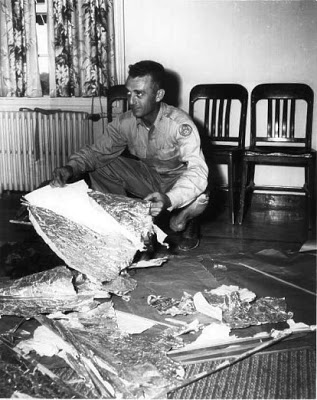
The affidavits say, among other things, that they found metal about as thin as tin foil that was yet extremely strong and had strange writings on it in an unknown language. It also says they took him to a hangar where they were holding an egg-shaped, apparently metallic object that was about 12-15 ft. long and about 6 ft. high with no windows, landing gear, or anything else. And it says he saw from a distance bodies partially covered by canvas that appeared humanoid yet didn’t have human-like bodily proportions. It also says they debated whether to reveal these findings to the public.

The reason this information stands out of the fray of UFO-related claims is because of whom the claims are by. Sure, there’s a lot of people who are crazy or just want attention and will say crazy things and make up stuff about UFOs, but that’s just because there are so many people that out of all the people, even given that the proportion of them who would lie or have delusions about this stuff is very small, it’ll add up to a sizeable number of claimers; but the number of people who were known to have been right in the middle of it all and who are expected to know what really happened is relatively small, so you have to consider the odds that a claimer from that relatively small group of people would happen to be insane or a pathological liar. And Walter G. Haut was probably about as central to the whole phenomenon as you could possibly get.

2) Jesse Marcel Jr. wrote a book called The Roswell Legacy. Jesse Marcel Jr’s dad, Jesse Marcel, was one of the first military people to arrive on the site of the Roswell crash (this fact is also mentioned in Wikipedia, https://en.wikipedia.org/wiki/Roswell_UFO_incident).

In the book Jesse Marcel Jr. talks about things his dad told him about the whole incident and wreckage that his dad brought home to show his family. According to the book, Jesse Marcel said that the government forced him to get pictures taken with him sitting next to a disassembled weather balloon (a now very famous set of pictures, here’s probably the most famous one: https://exalumen.blog/wp-content/uploads/2017/02/4e4c0-jessemarcel26balloonb.jpg), which wasn’t the original debris of the wreckage at all. He was actually furious about this, and the book says you can even see is incredulity at what he was forced to do in his facial expression in that picture.

The book also says that Jesse Marcel brought home debris from the crash because it was so interesting. It had strange alien writings on it (as Haut also says), and it was virtually indestructible (also as Haut says). Everything they tried do to it hardly even dented it.

There were probably even more significant things in this book than those, but it’s been a while since I read it and I don’t remember a whole lot.

3) The Disclosure Project’s 2001 National Press Club event: https://www.youtube.com/watch?v=lkswXVmG4xM. In this video, many high-ranking officials from various government agencies and DoD departments talk about their experiences with and knowledge about UFOs. Greer says The Disclosure Project has over 400 witnesses from the CIA, NSA, NRO, Air Force, Navy, Marines, Army, and corporate government contractors. I don’t know remember which or how many of those categories happen to be represented in this video, but there’s enough that it’s impressive.

The above two sources are outstanding for the same reason explained regarding the first source: the intersection between people in such select circles and the people who are crazy enough to make that kind of sht up is probably *very small, thus making it more probable that they’re telling the truth..

4) The government had actually issued a press release on the day of the crash, which was then reported in the Roswell Daily Record (http://www.angelfire.com/indie/anna_jones1/daily_record.html). It stated that they had recovered a “flying disc.” Then hours later they retracted that statement and said that it was a weather balloon. I’m sure the government didn’t confuse the flattened, foily debris of a weather balloon with a “flying disc”; even Haut said there was ‘”no chance” senior officers who handled the recovered material, including base commander Blanchard, mistook a weather balloon for a flying saucer’ (https://en.wikipedia.org/wiki/Walter_Haut).

This fact is significant to me because, while we know that the government often lies, they would have no reason to lie and say that they’d found a flying disc, so why would they say it if it weren’t true? On the other hand, it’s easy to imagine them lying and saying they hadn’t found a flying disc, in the general interest of secrecy or preventing mass panic, or whatever, and then subsequently trying to cover up their mistake by lying about it and saying it was something more trivial.

In fact the more you can imagine the government would be loath to make a statement as drastic and potentially upsetting as the claim that it found a flying disc, the more unlikely you’d think it would be for it to have issued such a statement spuriously, as in despite the fact that it’s not even true–IOW, at least if it’s true that gives them some motivation to publish it. (I’m not saying they generally reveal things just because they’re true, but in this case, they did make the claim, and I’m saying it’s unlikely enough that they would make such a claim if it’s true, but it’s even more unlikely they would make such a claim if it’s not true.)

5) Philip J. Corso, former Lieutenant Colonel and Chief of Foreign Technology at the Pentagon, published a book called The Day After Roswell that talks about “his personal stewardship of alien artifacts from the Roswell crash,” what was found there, how he spearheaded a project to reverse-engineer and apply alien technology, and the government cover-up of it all. (Again, the logic of the unlikelihood of the high-ranking officials and the crazy pathological liars being the same people applies.) The full text can be found here: https://archive.org/stream/DayAfterRoswell/TheDayAfterRoswell_djvu.txt

There’s a lot of elaborate, intricate and specific information in that book about the ongoings of various branches of the government regarding their reaction to the perceived alien threat. For him to have made all of that up just to perpetuate a huge lie would be nothing short of phenomenal. To say nothing, of course, of the principle I’ve already spoken of a few times regarding the likelihood of such prestigious people who would likely have access to such information being the same people who would want to gain attention by making up stories about aliens.

6) There is an abundance of accounts of air force pilots, airline pilots, etc. detecting, seeing, and even recording UFOs that fly without any visible means of propulsion, don’t leave a heat trail, and fly extremely quickly, many times faster than any man-made aircraft, and make hairpin turns at such speeds. The UFOs are detected on radar, seen with people’s own eyes, and in some cases recorded and some of those recordings have been made public.

To say more on the motives of the government to keep this stuff a secret, I have a pet theory that a lot of government measures, such as, for example, planning false flag operations like https://en.wikipedia.org/wiki/Operation_Northwoods, many actual covert operations from developing weapons to experimenting on people with LSD to infiltrating hippie culture with government agents, and a lot of its other general secrecy, are only considered necessary because people who are in the positions to make such decisions like to feel powerful (and maybe useful) so they invent these kinds of ‘solutions in search of problems’ and convince themselves that the ends justify the means.

(Regardless of whether this particular psychological theory is accurate, we do know without a doubt that the government, especially the military, likes to keep big secrets.)

To be fair though, in Corso’s book, in defense of the government’s choosing to keep all this information a secret, Corso says the following:

Many people have criticized the army and the government for maintaining the Roswell cover-up not only at the time but also through the years. For that, I need to say a word in defense of what the army did. It’s easy to criticize if you weren’t an adult back then or someone who didn’t understand the politics that governed our thinking at that point in American history. We had not yet fully made the transition from a nation at war
to a nation at peace.

And there was Harry Truman, still reeling from his sudden ascendancy to the presidency, toughened into steel by his decision to drop the atomic bombs on Japan, and now faced with the monumental impact of a crash landing of a strange craft on American soil. Was it Soviet? Did it belong to a foreign power? Was it hostile? We simply didn’t know and weren’t about to say anything until we knew what it was.

Was it a flying saucer? The last time a public announcement of a landing by extraterrestrials took place, even though it was entertainment, panic ensued. In the aftermath of the war and the fears surrounding the Cold War, we didn’t want to risk another panic. So the military recommended and the White House agreed to clam up. Just like the secrecy surrounding the Manhattan Project, no word gets out. And for the next fifty years that policy, once put into place, governed the behavior of the U.S. government and the military about the existence of UFOs and the crash at Roswell.

If it seems unlikely that the government could have kept such a huge secret for so long, consider that the military used very harsh and intimidating tactics such threats to people’s lives and the lives of their families, talking loudly and repeating the same thing over and over in people’s own homes, etc., to prevent them from speaking out about what they saw. And even with all their efforts to keep the secret, people speak out all the time, even the government officials as explained above. But it’s just not something that the average person hears or takes seriously when they do hear it, because of the stigma attached to the whole notion of aliens and UFOs.

One thing I’d like to note is that, while Corso’s book paints a picture of hostile aliens who were scheming to take over the earth and colonize it and the government subsequently developing technology to threaten them and down their crafts, I think this viewpoint is tragically misled. Everything in my explorations has led me to believe that the aliens are primarily just interested in observing us. The only reasons Corso gives for believing the aliens were hostile is basically that they buzzed military craft, hanged around military compounds, and, according to Corso, occasionally used EMPs against us. Of course, the EMPs, for all we know, could have been merely a side-effect of the operation of their craft, which, according to the book, apparently uses very intense electromagnetic fields to begin with.

Oh, and he also mentioned the human abductions and the cattle mutilations that were apparently done using instruments we didn’t even humanly have yet; but, while that seems to indicate somewhat menacing purposes, it’s a far cry from proving that they want to destroy us. It’s also very possible that the vast majority of aliens are completely passive and benevolent while minority factions or species have malevolent intentions. For example, I read once that the cattle mutilations were done by a minority of aliens who are negatively oriented just for the purpose of scaring us and making us think negatively about existence beyond and putting us into lower vibration, or something like that, and that they don’t really have the power to do anything bigger than that because we’re protected.

I personally believe that if a a species that has the ability to defy gravity, travel 7000 mph and turn on a dime, and travel between galaxies, or at least between stars, wanted to defeat us, we wouldn’t stand a chance, so there’s no use worrying about it or trying to develop technology to fight them because the fact that we’re still here means they don’t intend us any serious harm. Either that, or they couldn’t defeat us if the wanted to because they don’t even make weapons of destruction because they’re fundamentally peaceful, unlike our primitive, warring species that naturally tends to project its own immaturity onto more advanced species in the universe that we know nothing about yet. (Don’t believe anything Stephen Hawking says on the matter. I wrote more on that here: https://slashdot.org/comments.pl?sid=1630538&cid=31979040)

7) Oh, and crop circles. Some people have come forward claiming that they’re responsible for the crop circles and showed how they supposedly did it, but the thing is that research on crop circle plants has revealed features that wouldn’t occur under normal conditions. See http://www.bltresearch.com/plantab.php.